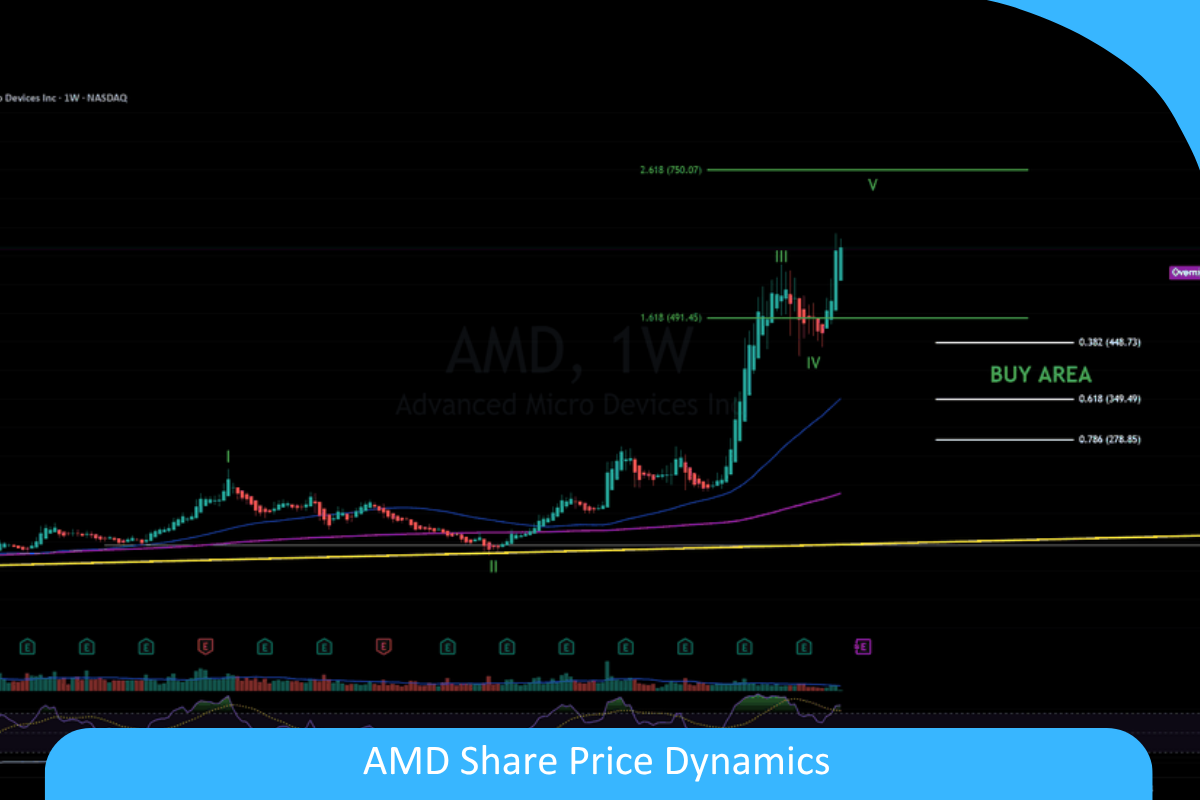
AMD share price dynamics reflect AI demand, data-center growth, margins, competition, and broader semiconductor cycles
Advanced Micro Devices has evolved from a traditional semiconductor manufacturer into a company closely associated with some of the biggest technology themes of the modern market. Its processors serve personal computers and gaming systems, while its data-centre products increasingly place the company within the competition for artificial intelligence infrastructure. That combination gives AMD substantial growth opportunities, but it also means its share price can respond sharply to changes in expectations.
Understanding AMD’s market valuation requires more than watching quarterly revenue or short-term price movements. Investors often need to consider AI accelerator demand, data-centre expansion, gross margins, product launches, competition, capital spending, and the broader semiconductor cycle together. Looking at these factors individually can provide useful context, but their interaction is what ultimately shapes how the market interprets the company’s prospects.
AI Accelerator Demand Is Reshaping AMD’s Growth Story
Artificial intelligence has become an important driver of semiconductor demand, particularly for specialised accelerators used to train and operate large computing models. AMD’s accelerator business has therefore become increasingly significant to how investors assess its long-term opportunity. The market is not simply evaluating whether AI demand exists, but whether AMD can translate that demand into sustained sales, stronger customer relationships, and meaningful earnings growth.
The competitive environment is particularly important. AI infrastructure is dominated by demanding technical requirements, and customers typically consider computing performance, software compatibility, energy efficiency, networking capabilities, availability, and total ownership costs. AMD’s ability to offer competitive accelerator products is consequently only one part of the equation. Its software ecosystem and ability to work closely with major cloud providers and enterprise customers can also influence adoption over time.
Expectations matter just as much as actual demand. Semiconductor companies can experience significant share-price movements when investors believe future AI revenue will grow faster or slower than previously anticipated. A strong product announcement may increase expectations, while delays, supply constraints, changing customer spending plans, or stronger competition can have the opposite effect. This makes AI an important opportunity for AMD, but also a source of heightened market sensitivity.
Data-Centre Growth and the Importance of Enterprise Spending
Data centres represent another major factor in AMD’s valuation. Cloud providers, technology companies, and enterprises continue to require large quantities of computing capacity, creating opportunities for processors and accelerators across a range of workloads. AMD’s server products benefit from demand for efficient computing, while its broader portfolio allows it to participate in several areas of the infrastructure market.
However, data-centre growth does not happen in a straight line. Large technology companies regularly adjust capital expenditure according to economic conditions, expected customer demand, infrastructure requirements, and the economics of new projects. A period of aggressive investment can benefit semiconductor suppliers, while a subsequent digestion period can create temporary pressure on orders. Investors therefore need to distinguish between structural demand for computing infrastructure and short-term changes in purchasing patterns.
The quality of growth also matters. Revenue expansion can be encouraging, but investors often pay close attention to whether growth is translating into sustainable profitability and cash generation. Increasing sales accompanied by improving operating leverage can create a different market response from revenue growth that requires substantial spending or produces limited incremental profit. This is why data-centre performance needs to be considered alongside AMD’s margins and overall financial structure.
Margins Can Influence How the Market Values Growth
Margins are particularly important for a semiconductor company because product mix, manufacturing costs, pricing, research and development spending, and competitive conditions can all influence profitability. Higher-value products may contribute more attractive economics, while intense competition or manufacturing challenges can place pressure on margins. As AMD expands into increasingly sophisticated computing markets, investors will naturally watch whether its product mix supports durable profitability.
The relationship between growth and margins can be especially important during periods of rapid AI investment. Developing advanced processors requires significant research, engineering, software development, and ecosystem investment. These expenses can weigh on near-term profitability while supporting future opportunities. The market therefore has to assess whether current investment is creating capabilities that can produce stronger economics over a longer period.
For investors examining the Advanced Micro Devices share price, this distinction can provide valuable perspective. A rising share price may reflect expectations for future margin expansion rather than only current earnings. Conversely, a decline does not necessarily mean demand has disappeared. It may indicate that investors are reassessing how quickly revenue can grow, how much investment is required, or how much profit can ultimately be generated from that growth.
Conclusion
AMD occupies an important position within several long-term technology trends, particularly the expanding need for high-performance computing and AI infrastructure. Its opportunities are significant, but so are the execution requirements. Product competitiveness, customer adoption, data-centre spending, margins, software development, and semiconductor cycles will all influence how the business develops over time.
For investors, the key is to separate short-term market movements from the underlying factors that can shape long-term value. Monitoring revenue quality, profitability, product progress, competitive conditions, and industry demand can provide a more balanced framework for understanding AMD.